
.png)





Show all
Business insights
How to Pay for ChatGPT Plus and the OpenAI API with a Card

31.08.2026
05
min to read

31.08.2026
.png)
For digital marketers and businesses scaling campaigns, understanding what a BIN is and how it works directly impacts your ad performance. Choosing the right card ranges helps you bypass automated risk flags, reduce decline rates, and protect your ad accounts from unexpected payment suspensions.
A BIN (bank identification number) is the initial 6 to 8-digit sequence on a payment card that identifies its issuing institution. Officially categorized as an Issuer Identification Number (IIN) under the global ISO/IEC 7812-1 standard, it reveals key details including the card network, account type, and country of origin.
Payment systems use this data to instantly verify card legitimacy and execute preliminary risk assessments.
The moment you enter a card number into a checkout field, the payment gateway extracts critical data, including:
This data retrieval happens in real time. For instance, when you type your card number on a checkout page, the system immediately displays a "Visa Platinum" icon before you even click submit. Ad platforms rely on these details to decide if your card meets their requirements.
In April 2022, the official ISO/IEC 7812-1 standard updated the format for bank identification numbers, expanding it from 6 to 8 digits. This change was introduced to handle the skyrocketing global demand for payment cards and boosted the available pool of unique card ranges from roughly 100,000 to nearly 10 million.
Total card length (the 16-digit PAN) remained the same — the BIN simply absorbed two digits previously used for account identification. Today, both 6-digit and 8-digit BINs coexist across payment processing networks, though new card issues increasingly feature the longer 8-digit structure.
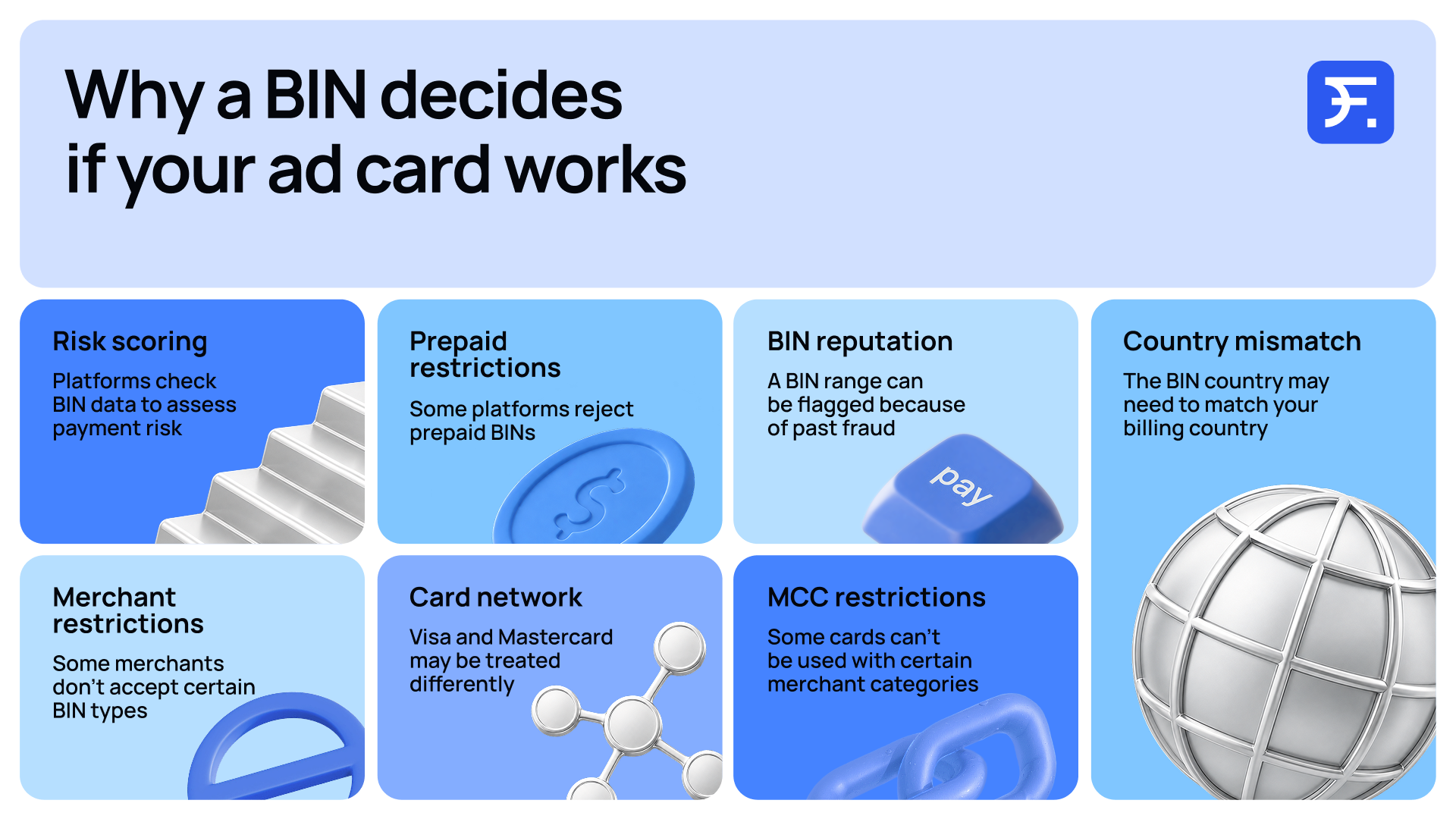
For marketers, the core meaning of a BIN is automated trust checks. Before any money is moved, ad networks read those leading digits to calculate your risk level, often leading to a BIN ad card declined error for these key reasons:
The moment you enter a card, the ad platform’s security system scans the BIN to evaluate account safety. If the parameters don't align with their internal risk thresholds, the system rejects the card.
Major advertising networks and services like Meta, Google, and OpenAI decline prepaid BIN ranges. Because prepaid cards carry higher chargeback rates and lower accountability, platforms prefer standard credit or debit numbers.
You share a BIN range with thousands of other cardholders. If someone uses cards from that same issuer batch for fraud, chargebacks, or unpaid ad bills, the entire BIN range can get blacklisted, which may cause your card to be declined even though you did nothing wrong.
If your card’s BIN points to one country while your ad account, billing address, or proxy location indicates another, anti-fraud filters flag the mismatch as potential unauthorized card use and block the transaction instantly.
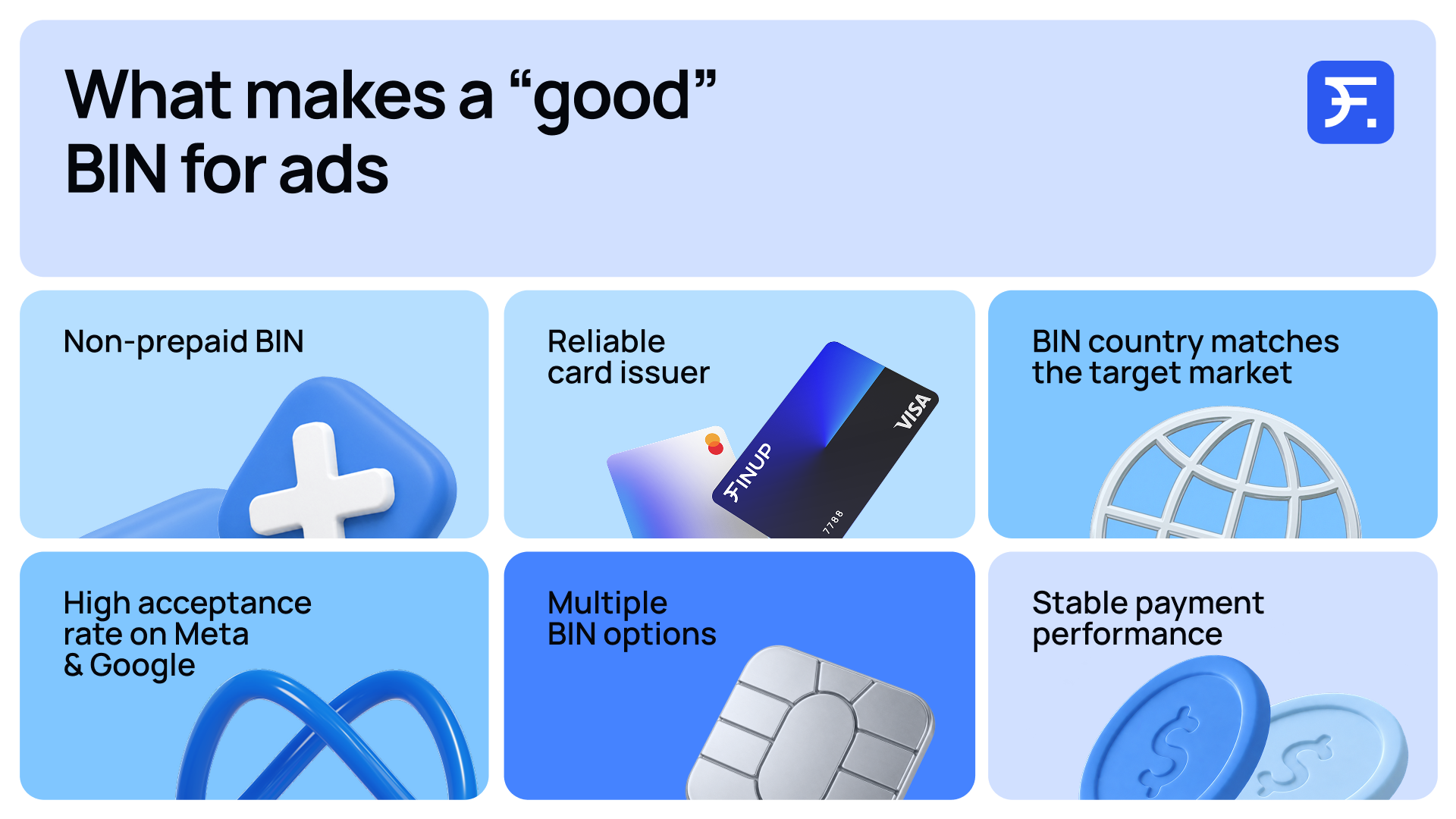
A high-performing virtual card BIN for advertising relies on merchant trust and operational stability. To avoid an unexpected Facebook BIN decline or Google alert, a reliable ad payment setup should feature:
Finup knows what a reliable BIN is, which is why the platform offers access to various BINs from trusted global issuers.
Instead of being limited to one card type, you can choose the best BIN range for your account's region, currency, and ad platform from the start. This simple step helps your payments go through without any issues.
And if a specific bank range ever runs into temporary problems or starts getting declined on a certain ad platform, you won't have to stop your ads. You can simply switch to a new card with another BIN and keep your campaigns running without interruption.
A BIN (short for bank identification number) refers to the first 6 to 8 digits on any debit or credit card. The ISO/IEC 7812-1 standard strictly recognizes these initial figures as an Issuer Identification Number (IIN), which reveals the financial institution that issued the card, along with its payment brand, account category, and nation of origin.
While a bank identification number traditionally contained 6 digits, Visa and Mastercard officially transitioned to an 8-digit format in April 2022 to meet growing global card demand. As a result, both 6-digit and 8-digit versions remain active today, though newly assigned card ranges use 8 digits.
Before processing a payment, the system checks these first digits to instantly see the card's network, bank, type (credit/debit/prepaid), tier, and country. This quick check helps spot potential payment issues, like a BIN ad card declined error, before the charge is even sent through.
Ad networks check BINs for fraud risks. If the numbers show it’s a prepaid card, don't match your billing country, or belong to a flagged card batch, the platform can block it right away—even with enough money in your account.
No single golden number exists. The ideal choice is a standard (non-prepaid) credit or debit card issued by a reputable bank in a region matching your account's location details. To prevent a BIN ad card declined issue, maintaining access to cards across multiple card ranges is far more effective than searching for one specific sequence. This will let you swap cards if an ad network flags a particular issuer batch.
Both terms describe the exact same set of leading digits. "IIN" (Issuer Identification Number) is the formal ISO/IEC 7812 classification, whereas "BIN" is the traditional term widely used across the banking sector. The two acronyms can be used synonymously.
Ready to scale your ad campaigns without payment interruptions? Get instant access to high-converting BINs with Finup so you can find the best BIN for Facebook Ads and keep your spending uninterrupted.
.png)
%20EN%20cover.png)
%20cover%20(1).avif)
